
- Legal entity: Dongguan Zhuohang Ltd, registration 91441900MA4UWT6X39, founded 2005.
- 6,800 m² campus — two buildings: workshop (production / inspection / office) and employee dormitory + canteen.
- over a hundred machines — 3-axis (50+), 4-axis (20+), 5-axis (20+), 25+ lathes, 7+ grinders.
- ISO 9001 + IATF 16949 + ISO 14001, all verifiable by certificate number.
Is this a real factory or a trading company?
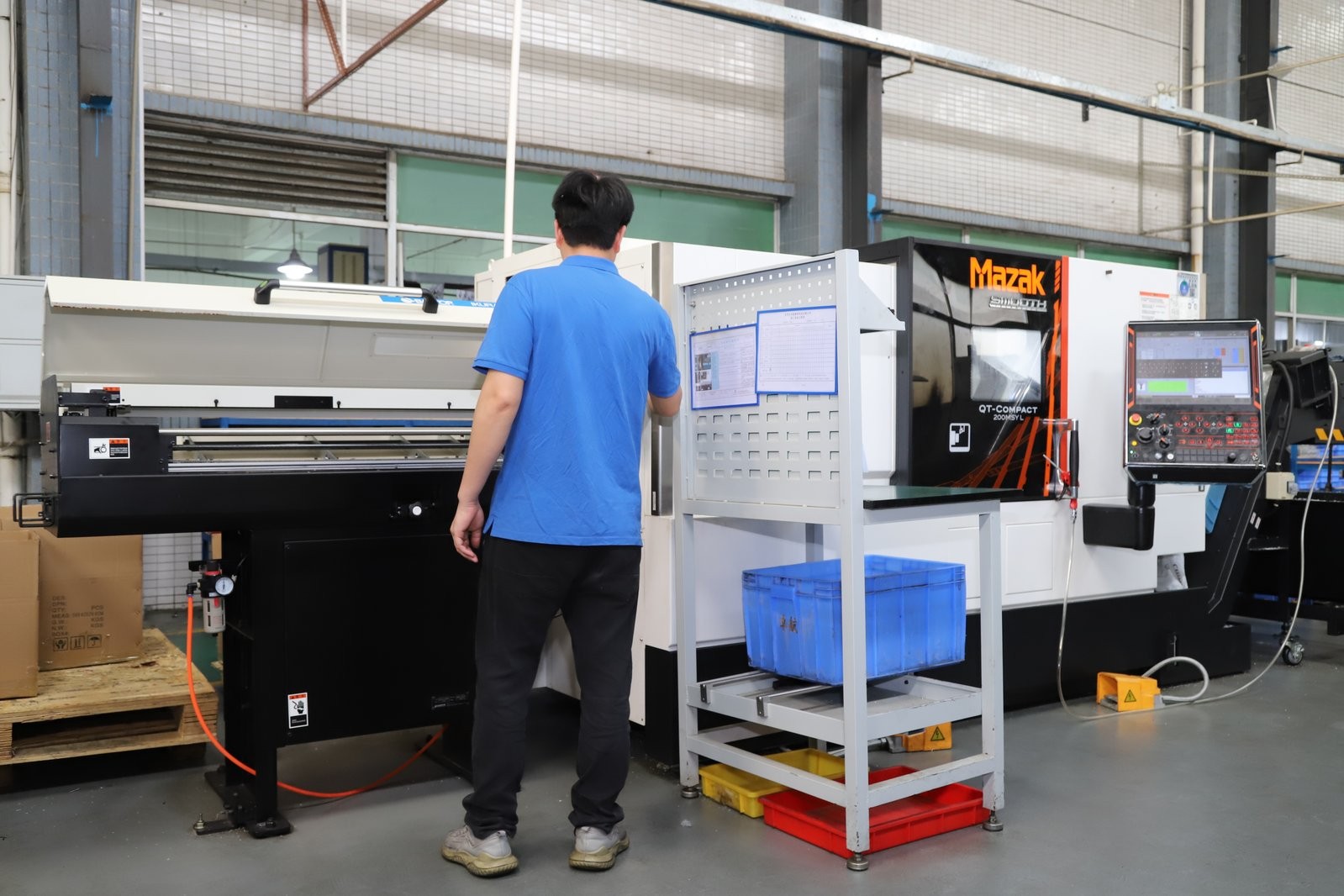
It is a real factory, and you can prove it the way you should: by walking the floor. The legal entity is Dongguan Zhuohang Ltd, registration 91441900MA4UWT6X39, founded in 2005. The campus is at No. 8, Shuibian Songyuan Road, Hengli Town, Dongguan — a single self-contained manufacturing site, not a shared office or a virtual address.
A trading company recycles brochures and stock photos; a manufacturer names its machines and opens its doors. This is the latter. Ask for the registration documents, or come and see the equipment list matched to the floor.
What does the campus actually look like?
The site is a 6,800 m² campus with two buildings. One is the workshop, holding production, inspection, and offices under one roof. The other is employee dormitory and canteen. This matters to a buyer because a plant with on-site worker housing and dining is a permanent, staffed operation, not a thin shell that moves when the order dries up. It is also why the address does not carry a building number: there is no confusing multi-building numbering, just the workshop and its support building.
What machines run on the floor?
The equipment list is specific enough to audit. Across the workshop:
| Process | Count | Representative machine families |
|---|---|---|
| 3-axis milling | 50+ centers | Brother SPEEDIO, Mazak VCE |
| 4-axis milling | 20+ centers | Mazak VCE with 4th-axis indexing |
| 5-axis milling | 20+ centers | Mazak VARIAXIS |
| Mill-turn | Multi-task | Mazak INTEGREX, Mazak QT |
| Swiss-type turning | Precision lathes | Citizen Cincom, Star SR, Tsugami |
| Grinding | 7+ | Surface, centerless, cylindrical |
These are named, purchasable machine families you can look up, not a vague "advanced equipment" claim.
What inspection equipment sits beside the machines?

A factory that cannot measure cannot prove anything. The inspection bench is the same class of equipment a buyer would use to audit the shop.
- Hexagon GLOBAL S CMMs for dimensional verification, plus a gear measuring center and vision measuring machines.
- KEYENCE VK-X3000 laser microscope and SURFCOM 1800D for surface finish and profile.
- XRF (iCHEQ) spectrometer for incoming material composition checks against the mill certificate.
- HVS-1000A micro-Vickers hardness tester, Fischer coating gauge, salt spray and tensile testers.
Which certifications back the factory?
Certifications are the cheapest pre-audit you can run. Three are held, with scope stated honestly rather than inflated.
| Standard | Certificate number | Scope |
|---|---|---|
| ISO 9001:2015 | 116024/A/0001/UK/En | Machining of metal parts |
| IATF 16949:2016 | 131941/A/0001/SM/En | Manufacture of CNC metal machining parts (excludes product design, Clause 8.3) |
| ISO 14001:2015 | 116024/B/0001/UK/En | Environmental management related to machining of metal parts |
Honest scope note: IATF 16949 excludes product design under Clause 8.3. This is a build-to-print operation — if a program needs design ownership, that is scoped up front rather than over-promised.
How are customer IP, labor, and the environment handled?
A serious factory has answers for the questions beyond the machine list. Here they are, stated plainly.
- IP protection: sensitive paper files in a secure space, electronic data on encrypted drives, responsible use and disposal per policy.
- Labor: no forced labor, no child labor, employment contracts and social insurance for all employees, reasonable working hours.
- Environment: ISO 14001 management system, with solar power generation on site.
What should a buyer check before trusting a factory?
Whether you buy from this factory or any other, these five checks separate a real manufacturer from a trading desk. Run them on us — we welcome it.
- The machine list is specific. Models and counts, not "advanced equipment."
- The address resolves to a real plant. A self-contained campus, not a shared office.
- The registration number checks out. 91441900MA4UWT6X39, verifiable in the business registry.
- The certificates have numbers. You can confirm them with the registrar.
- The doors open. A factory visit or live video walk-through is available on request.
Send a drawing and we will run all five checks on ourselves for you, in writing, before you commit.
How does a part move through the factory floor?
A verifiable factory is a sequence of gates, not a pile of machines. Following a part end to end shows where the control points live.
- Material gate. Incoming stock is checked by XRF spectrometer against its mill certificate before it reaches a machine, so a substituted or mixed lot is caught at the door.
- Machining. The part routes to milling, turning, mill-turn, or grinding by geometry — round parts turn, prismatic parts mill, concentric parts mill-turn, critical faces grind.
- Secondary operations. Heat treatment and surface finishing run through qualified partners where the in-house oven range does not cover the requirement, and that routing is disclosed on the quote.
- Inspection. Critical dimensions are measured on Hexagon GLOBAL S CMMs, with surface finish and profile on a KEYENCE VK-X3000 laser microscope and a SURFCOM 1800D.
- Packing and shipping. Finished parts are packed with the documents — material certificate, inspection report, and SPC charts — so what arrives is what was measured.
Every step is recorded in the MES/ERP system: raw material source and usage, process parameters, machine data, batch, operator, and inspection results. A non-conformance can be traced to the specific lot, machine, and operator — and contained — instead of guessed.
How do the machine counts translate into capacity?
A mixed fleet matters more than a big fleet, because it means most parts stay under one roof without being routed through a bottleneck. The 100+ production machines break down across 3-axis (50+), 4-axis (20+), and 5-axis (20+) milling, 25+ lathes, and 7+ grinders. That spread covers the two ends of the work a buyer actually sends: a one-off prototype that needs a single machine, and a production run that needs several machines in parallel without one process starving the others.
For 4-axis work specifically, 20+ 4-axis centers means a multi-face part does not wait in a queue behind a single rotary machine — the axis is a standard routing option, not a scarce exception. That is the difference between a shop that owns 4-axis as a process and one that treats it as a special request.
The same logic applies to the headcount and floor. The 6,800 m² campus and 100+ people mean the plant is staffed to run continuously, with on-site worker housing and a canteen in a second building — a permanent operation, not a thin shell that scales down the moment the order book dips.
How are export and logistics handled?
Exporting machined parts is a matter of terms, documents, and packaging, and all three are decided up front rather than discovered at the dock. The commercial terms follow standard Incoterms, so both sides agree on where risk and cost transfer:
| Term | What it means for you |
|---|---|
| EXW (Ex Works) | you collect at the factory gate and arranges all carriage. |
| FOB (Free On Board) | The seller delivers to the port and clears export; you pay freight and insurance. |
| CIF (Cost, Insurance, Freight) | The seller pays freight and insurance to the destination port. |
| DAP (Delivered at Place) | The seller delivers to a named destination, with import clearance on the buyer. |
| DDP (Delivered Duty Paid) | The seller clears import and pays duties to the named destination. |
The documents that ship with the parts are the same evidence you audit on site: the material certificate, the CMM inspection report, and the SPC charts. Packaging is matched to the geometry — machined surfaces protected from transit damage — so a part that measured right does not arrive knocked out of tolerance.
What does the inspection bench actually prove?
Each instrument on the bench proves one specific claim, and the list is more useful when you know which claim each one backs.
- Hexagon GLOBAL S CMMs prove dimensional accuracy against the drawing, including cross-face relationships.
- KEYENCE VK-X3000 laser microscope and SURFCOM 1800D prove surface finish and profile to an Ra value.
- XRF (iCHEQ) spectrometer proves the alloy composition matches the mill certificate.
- HVS-1000A micro-Vickers proves hardness after heat treatment.
- Fischer coating gauge proves plating and coating thickness.
- Salt spray and tensile testers prove corrosion resistance and mechanical strength.
The point is not that the bench is large; it is that every claim a buyer might want to verify has an instrument assigned to it. Ask the shop to show which instrument backs each requirement on your print, and the answer separates a documented quality system from a slogan.
What should you expect during an on-site audit?
A factory visit is the fastest way to turn a claim into evidence, and a shop that welcomes one behaves differently from one that stalls. During the visit, walk the floor in this order and match what you see to what was promised in writing.
- Match the machine list to the floor.The named machine families should be present, running or in setup, not photographed from a brochure.
- Watch a part move. Follow one job from the material gate through machining to inspection, and confirm the routing matches the DFM notes.
- Ask to see a live measurement. A CMM run on a real part, in front of you, is worth more than any certificate on the wall.
- Check the paper trail. The MES/ERP record should tie a lot back to its raw material, machine, operator, and inspection results without hesitation.
A live video walk-through can cover the same ground when travel is not possible, but the discipline is the same: match what you are shown to what was written, and treat any gap as a finding.
What this shop actually runs
We machine every part in our own 6,800 m² plant in Dongguan, China, on 100+ CNC machines with 100+ staff. The machine list by category:
- 5-axis machining centres (10+) - Mazak VARIAXIS I-600 (510/910/510 mm travel, 12,000 rpm, 22 kW, 71.6 N·m, 30-tool BT40) and Mazak INTEGREX I-250H S (B-axis 0.0001°, 24 kW, 124 N·m, 38-tool HSK-A63). Cut on compound-angle parts, single-setup multi-face prismatic work, and aerospace fittings where datum transfer loss is unacceptable.
- 3-axis / 4-axis machining centres (50+) - Brother SPEEDIO S500Z2N / S700Z2N (10,000 rpm, 14/21-tool ATC, 0.7 s tool-to-tool, Z-axis 2.2 G) and Mazak VCE-430A L / VCE-570C L (10,000 rpm, 118 N·m, 24-tool ATC). Cut on prismatic parts, plates, brackets, housings.
- Swiss-type turning centres (10+) - Citizen Cincom A20-3F7 (Φ20 mm, 10,000 rpm), TSUGAMI B0206-III / B0205-III (Φ20 mm, 0.1 µm), STAR SR-32JII / SR-32J Type N (Φ32 mm, 8,000 rpm). Cut on long, slender rotational parts at ±0.002 mm.
- CNC turning centres (20+) - HEADMAN T70M/1250 (720 mm swing, 117 mm bore, 3,000 rpm, BMT75 12-station turret). Cut on shafts, bushings, flanges up to ±0.002 mm.
- Wire EDM (5+) - Sodick AQ535L (550/350/300 mm travel, ±20° taper, 800 kg workpiece). Cut on hardened tool steel, internal splines, sharp internal corners that milling cannot reach.
- Inspection: Hexagon CMM + 20+ gauges - Hexagon CMM for coordinate measurement, plus vision system, profilometer, hardness tester, coating thickness gauge, XRF for material verification. The 10:1 rule (gauge 10x more accurate than the band) is applied to every feature.
- Machine highlights - VARIAXIS I-600: one-setup multi-face 5-axis + MAZA-CHECK auto-calibration; INTEGREX I-250H S: DONE-IN-ONE mill-turn, B-axis 0.0001° + Ai thermal shield; SPEEDIO S500Z2N / S700Z2N: Z-axis 2.2 G + 0.7 s ATC; Swiss-type: guide-bush switchable + 0.1 µm resolution.
Tolerance: ±0.003 mm CNC milling / ±0.002 mm CNC turning / ±0.002 mm grinding and wire EDM. Capability: Ppk >= 1.67 initial on key characteristics, Cpk >= 1.33 ongoing.
Certificates: ISO 9001:2015 (116024/A/0001/UK/En), IATF 16949:2016 (131941/A/0001/SM/En, with design clause 8.3 excluded, stated openly) and ISO 14001:2015 (116024/B/0001/UK/En), issued to Dongguan Zhuohang Ltd, registration 91441900MA4UWT6X39, founded 2005.
Where we ship: Austria, Belgium, the Czech Republic, Denmark, France, Germany, Greece, Hungary, Ireland, Italy, the Netherlands, Spain, Sweden and the United Kingdom in Europe; Brazil, Canada, Mexico and the United States in the Americas; China, Israel, Japan, Singapore and Sri Lanka in Asia; Australia and New Zealand in Oceania; and South Africa in Africa — plus other countries and regions worldwide, shipped from our base in Dongguan, China.
Contact: Felipe Iglesias, [email protected], +86 13126536955.
Come audit the factory — the doors are open.
Email [email protected] or call +86 13126536955 to schedule a visit or live video walk-through.
Frequently Asked Questions
Are you a real factory or a trading company?
A real factory, auditable on site. The legal entity is Dongguan Zhuohang Ltd, registration 91441900MA4UWT6X39, founded 2005, operating a 6,800 m² campus at No. 8, Shuibian Songyuan Road, Hengli Town, Dongguan.
Can I visit or audit the factory?
Yes. Visits and audits are welcome at No. 8, Shuibian Songyuan Road, Hengli Town, Dongguan, Guangdong, China 523470. Contact [email protected] to schedule, and state what you want to see.
What machines do you run?
100+ production machines across 3/4/5-axis milling (50+/20+/20+), turning (25+), and grinding (7+), with Brother SPEEDIO, Mazak VCE and VARIAXIS centers, Mazak INTEGREX and QT mill-turn, and Citizen and Star Swiss-type lathes.
Which certifications do you hold?
Yes — ISO 9001:2015 (116024/A/0001/UK/En), IATF 16949:2016 (131941/A/0001/SM/En), and ISO 14001:2015 (116024/B/0001/UK/En), each with a number you can verify with the registrar. The IATF scope excludes product design under Clause 8.3.
What is the facility like?
A 6,800 m² campus with two buildings: one is the workshop for production, inspection, and offices, and the other is employee dormitory and canteen. This is a self-contained manufacturing site, not a shared or virtual office.
How do you protect customer IP?
Sensitive paper files are stored in a secure space and electronic data on encrypted drives, with responsible use, storage, and disposal of customer data per documented policy. Confidentiality and IP protection are part of the code of conduct.
What are the labor and environmental practices?
No forced labor, no child labor, employment contracts and social insurance for all employees, reasonable working hours, and environmental management under ISO 14001 with solar power generation on site.
How do I verify the company registration?
The registration number is 91441900MA4UWT6X39, legal name Dongguan Zhuohang Ltd, founded 2005. You can check it with the Chinese business registry, or ask us for the registration documents during a visit.
Do you design parts or only build to print?
In short, This is a build-to-print operation. The IATF 16949 scope excludes product design under Clause 8.3, so if a program needs design ownership it is scoped up front rather than over-promised.
What languages can I work in?
English, Portuguese, Spanish, French, and Chinese. Drawings, DFM flags, and quotes are returned in the language you write in, so a tolerance discussion does not get lost in translation.
What lead times do you offer?
Roughly 3, 7, or 30 days depending on complexity and the number of process steps. Simple parts ship in about 3 days; parts with many operations or surface finishing land in the 30-day tier.
Continue reading: 3 Axis CNC Machining · 5 Axis CNC Machining
Standards referenced on this page
- ASTM A582/A582M-12 — Standard Specification for Free-Machining Stainless Steel Bars
- ISO 14001 — Environmental management systems — Requirements with guidance for use
- ASTM E8/E8M-21 — Standard Test Methods for Tension Testing of Metallic Materials