
Definition and operational chain — what CNC machining is and how an order runs
CNC machining is a subtractive process — a computer-controlled machine removes material from a billet to leave the part. The machine reads G-code, moves a spindle along programmed axes, and cuts metal or plastic with a rotating tool. The tolerance a machine holds depends on the machine, the fixture, the tool, and the inspection, not on the country the machine sits in. A Mazak VARIAXIS I-600 in Dongguan holds the same ±0.003 mm it holds in Nagoya or Chicago; a Hexagon CMM reports the same dimensional result regardless of the postcode.
The operational chain runs quote, material, fixture, programming, setup, production, inspection, packing, ship. The quote breaks out the material, the setup, the cycle, and the inspection as separate lines. The material is ordered against the specified grade, with the certificate from the mill carrying the heat number. The fixture is designed and built in-house. The program is proven on the machine before the first cut. The first-article inspection runs against the drawing, and the production begins once the first article passes. The inspection is the Hexagon CMM, the vision system, the profilometer, the hardness tester, and the gauges, with the 10:1 rule applied to every feature.
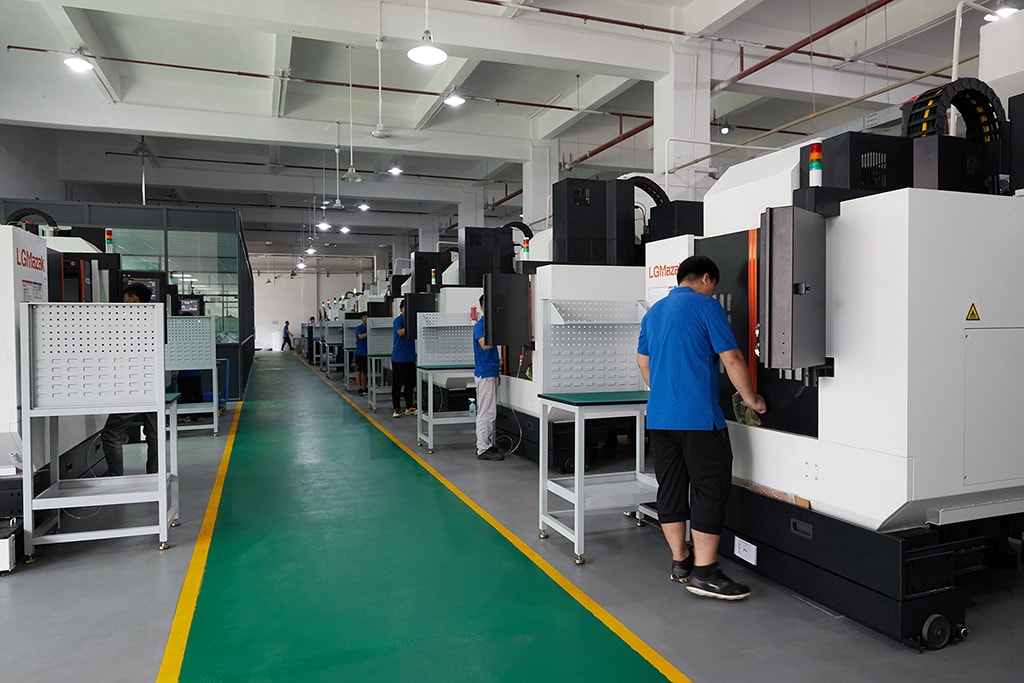
The chain runs under ISO 9001:2015, IATF 16949:2016 (design clause 8.3 excluded), and ISO 14001:2015, with ±0.003 mm milling and ±0.002 mm turning and grinding bands and Ppk ≥ 1.67 initial and Cpk ≥ 1.33 in production. The facility behind this guide runs 100+ CNC machines on a 6,800 m² floor in Dongguan, including Mazak VARIAXIS I-600 five-axis, Mazak INTEGREX I-250H S mill-turn, TSUGAMI and STAR and CITIZEN Swiss-type turning, and 3/4/5-axis milling. Contact Felipe Iglesias at [email protected] or +86 13126536955 to walk through the chain for a specific part.
- Build-to-print manufacturing: the plant cuts to your design and reports against your drawing.
- 6,800 m² across two buildings in Hengli Town, Dongguan — production, inspection, and engineering under one roof.
- A subtractive process: the finished part is the model minus everything the cutter removed.
- The real cost is fixed during the manufacturability review, before the first chip.
- No minimum order, prototype and production run on the same machines.
Failure modes and their controls
The failures that cost money are rarely dramatic. They are the quiet ones: a tolerance held on the machine and lost in a later operation, a revision built from a superseded drawing, and a surface finish callout that means something different under another standard.
Each has a cheap control. Datum structure reviewed at quote stage, revision confirmed in writing on the order acknowledgement, drawing standard confirmed when the files arrive. None cost anything, which is what makes their absence hard to excuse.
Defining 4 axis CNC machining in practical terms
4 axis cnc machining is a subtractive process: a rotating cutter removes material from a solid block or bar under numerical control, following a toolpath generated from a 3D model. The part that comes off the machine is the model, minus everything the cutter removed.
The distinction that matters commercially is between having the capability and having the depth. A plant with one machine in a family can make the part; a plant with twenty can make it on the week you need it, and re-route it when something breaks.
The sequence behind a finished part
The sequence is quoting and manufacturability review, then programming and offline verification, then fixturing, then roughing, then finishing, then inspection and first-article reporting. Each step has a failure mode, and the costly failures sit at the start and the end.
The manufacturability review is where cost is actually decided. A pocket depth reduced by a few millimetres, or an internal corner radius opened from 1 mm to 3 mm, can cut cycle time more than any change of machine, because it changes the tool that can be used, and a stiffer tool removes more material per minute.
What does 4 axis CNC machining cost, and what drives it?
Cost is driven by setup time amortised over quantity, cycle time, material and tooling, inspection labour, and the risk premium on the tolerance. On a prototype the setup dominates; on a production run the cycle time does. That is why a per-part price without a quantity is not a price.
The driver buyers most often underestimate is inspection. A drawing that calls out twenty dimensions has a different inspection cost from one that calls out five, and a first-article report is a real document that has to be written.
What fails on this process, and when
The failures that cost money are not crashes. They are the quiet ones: a tolerance held on the machine but lost in a later operation, a revision built from a superseded drawing, and a surface finish callout that meant something different in another standard.
Each has a cheap control. Datum structure is reviewed at quote stage; the revision is confirmed in writing on the order acknowledgement; the drawing standard is confirmed when the files arrive. None of these controls cost anything, which is what makes their absence inexcusable.
How do you tell whether a 4 axis CNC machining supplier actually runs it?
These four checks cost nothing and can be run before any commitment.
- Can they name the registration number? Ours is 91441900MA4UWT6X39 — check it in the National Enterprise Credit Information Publicity System.
- Do they name machine families and counts? A manufacturer lists models; a reseller recycles stock photos.
- Are the certificate numbers verifiable? Real ISO/IATF certificates carry numbers you can confirm with the registrar.
- Can you walk the floor? On-site and video audits are welcome at the Dongguan address.
What design decisions move the cost on 4 axis CNC machining?
Three design decisions drive most of the cost on a machined part: internal corner radii matched to a real cutter diameter, cavity depth kept within about four times the tool diameter, and a general tolerance on every feature that does not mate. Each one changes the tool that can be used, and the tool determines how much material can be removed per minute, which is why these matter more than any process selection.
This is cheaper to settle at quote time than once parts already exist, because the changes are usually trivial on the drawing and significant on the machine.
Who is on the other side of the purchase order?
Legally this is Dongguan Zhuohang Ltd, established 2005, Social Credit Code 91441900MA4UWT6X39, operating under the name Zhuohang Precision Machining Factory from No. 8, Shuibian Songyuan Road, Hengli Town, Dongguan, Guangdong, China 523470.
The 18-character code, checked against the National Enterprise Credit Information Publicity System, confirms a real manufacturer. A trading company may hold a business licence as well, but its scope is trading, not manufacturing, and its address is an office rather than a plant.
Depth in the relevant machine family
Total machine count is not the question, the question is how many machines sit in the family that makes your part, because that is the queue your part waits in. The floor runs a floor of 100-plus machines: 50+ three-axis centres for prismatic work, 20+ four-axis, 20+ five-axis, 25+ turning and mill-turn centres, Swiss-type lathes for long slender parts, precision grinding and wire EDM for the tightest features.
The spare capacity in that family is what lets a part send work to a free machine instead of letting it wait when a machine is pulled for service. That, not the headline machine, is what protects a delivery date.
What is the certification position?
ISO 9001:2015, IATF 16949:2016 (excluding clause 8.3 product design), and ISO 14001:2015, each with a certificate number verifiable with the registrar.
What tolerance applies?
±0.003 mm on CNC milling, ±0.002 mm on CNC turning; ±0.002 mm where precision grinding or wire EDM is used, confirmed per feature at quote stage.
What 4-axis CNC machining actually is, in plain terms
4-axis CNC machining is a subtractive process: a rotating cutter or a fixed tool removes material from a block until the finished shape remains. What separates it from other ways of making parts is the control - every axis, feed and depth of cut is driven by a computer program, so the same geometry comes out the same way on the first part and the ten-thousandth. For you, that control is the point: it is how a part drawn to ±0.003 mm actually arrives at ±0.003 mm, and how a one-off prototype and a production run come off the same setup with the same result.
How it fits the wider manufacturing picture
Against casting and forging, 4-axis CNC machining needs no tooling, so it is the fastest route from a CAD model to a physical part and the cheapest way to make a small quantity. Against 3D printing, it wins on tolerance, surface finish and material choice - a milled metal part is denser and stronger than a printed one, and it holds a far tighter band. The trade-off is that material is cut away rather than added, so there is waste, and very high volumes usually move to a near-net-shape process first. If you understand that trade-off, you place 4-axis CNC machining exactly where it earns its keep: precise, low-to-mid-volume metal and plastic parts.
What you need to start a quote
Two files get you a quote: a STEP or IGES model and a 2D drawing that carries the tolerances, surface finish and material. The drawing is what defines the contract - the model alone usually leaves the tolerance scheme unspecified. Send them to Felipe Iglesias at [email protected] or +86 13126536955 with the quantity, and the quote reflects the real process. MOQ is 1 piece, and lead times run roughly 3 / 7 / 30 days depending on the material and the documentation scope.
What this shop actually runs
We machine every part in our own 6,800 m² plant in Dongguan, China, on 100+ CNC machines with 100+ staff. The machine list by category:
- 5-axis machining centres (10+) - Mazak VARIAXIS I-600 (510/910/510 mm travel, 12,000 rpm, 22 kW, 71.6 N·m, 30-tool BT40) and Mazak INTEGREX I-250H S (B-axis 0.0001°, 24 kW, 124 N·m, 38-tool HSK-A63). Cut on compound-angle parts, single-setup multi-face prismatic work, and aerospace fittings where datum transfer loss is unacceptable.
- 3-axis / 4-axis machining centres (50+) - Brother SPEEDIO S500Z2N / S700Z2N (10,000 rpm, 14/21-tool ATC, 0.7 s tool-to-tool, Z-axis 2.2 G) and Mazak VCE-430A L / VCE-570C L (10,000 rpm, 118 N·m, 24-tool ATC). Cut on prismatic parts, plates, brackets, housings.
- Swiss-type turning centres (10+) - Citizen Cincom A20-3F7 (Φ20 mm, 10,000 rpm), TSUGAMI B0206-III / B0205-III (Φ20 mm, 0.1 µm), STAR SR-32JII / SR-32J Type N (Φ32 mm, 8,000 rpm). Cut on long, slender rotational parts at ±0.002 mm.
- CNC turning centres (20+) - HEADMAN T70M/1250 (720 mm swing, 117 mm bore, 3,000 rpm, BMT75 12-station turret). Cut on shafts, bushings, flanges up to ±0.002 mm.
- Wire EDM (5+) - Sodick AQ535L (550/350/300 mm travel, ±20° taper, 800 kg workpiece). Cut on hardened tool steel, internal splines, sharp internal corners that milling cannot reach.
- Inspection: Hexagon CMM + 20+ gauges - Hexagon CMM for coordinate measurement, plus vision system, profilometer, hardness tester, coating thickness gauge, XRF for material verification. The 10:1 rule (gauge 10x more accurate than the band) is applied to every feature.
- Machine highlights - VARIAXIS I-600: one-setup multi-face 5-axis + MAZA-CHECK auto-calibration; INTEGREX I-250H S: DONE-IN-ONE mill-turn, B-axis 0.0001° + Ai thermal shield; SPEEDIO S500Z2N / S700Z2N: Z-axis 2.2 G + 0.7 s ATC; Swiss-type: guide-bush switchable + 0.1 µm resolution.
Tolerance: ±0.003 mm CNC milling / ±0.002 mm CNC turning / ±0.002 mm grinding and wire EDM. Capability: Ppk >= 1.67 initial on key characteristics, Cpk >= 1.33 ongoing.
Certificates: ISO 9001:2015 (116024/A/0001/UK/En), IATF 16949:2016 (131941/A/0001/SM/En, with design clause 8.3 excluded, stated openly) and ISO 14001:2015 (116024/B/0001/UK/En), issued to Dongguan Zhuohang Ltd, registration 91441900MA4UWT6X39, founded 2005.
Where we ship: Austria, Belgium, the Czech Republic, Denmark, France, Germany, Greece, Hungary, Ireland, Italy, the Netherlands, Spain, Sweden and the United Kingdom in Europe; Brazil, Canada, Mexico and the United States in the Americas; China, Israel, Japan, Singapore and Sri Lanka in Asia; Australia and New Zealand in Oceania; and South Africa in Africa — plus other countries and regions worldwide, shipped from our base in Dongguan, China.
Contact: Felipe Iglesias, [email protected], +86 13126536955.
Not sure this is the right process?
Send the model and the drawing and get a straight answer on whether this route is the right one, including where a design change would cut cost. Reach Felipe Iglesias at [email protected] or +86 13126536955.
Frequently Asked Questions
Do you hold stock or consignment for repeat orders?
Repeat orders can run against a forecast so stock and, where the part warrants it, dedicated fixturing are held ready. This is a commercial arrangement, not a standard term, so raise it at the second order rather than the first.
Is your IATF 16949 certificate valid for design work?
No. The certificate excludes clause 8.3 (product design). The plant is certified to manufacture to your design and to run the associated process controls, not to originate product design.
How long does 4 axis cnc machining take?
Lead time is driven less by cutting time than by queue position, fixture design, and inspection. A part that needs a purpose-built fixture has a longer first-article lead and a much shorter repeat lead, which is worth asking about separately.
What materials do you machine?
Aluminum, stainless steel, titanium, brass, copper, and Inconel for metals; PEEK and Delrin (POM) for plastics. Material certificates are verified on incoming stock.
How is an engineering change handled mid-production?
The change is documented against a revision, the affected parts in process are identified, and the revised drawing is confirmed in writing before work restarts. The important part is that the revision in force at any moment is a single, written one.
How is material traceability maintained?
Incoming stock is checked against the mill certificate — composition by XRF, hardness where specified — and traceability is held per heat or per batch as the certificate defines it.
Are you a manufacturer or a trading company?
A manufacturer. The registered entity is Dongguan Zhuohang Ltd (No. 91441900MA4UWT6X39), a 6,800 m² facility with 100+ machines and 100+ staff in Dongguan, open to factory visits.
Continue reading: 3 Axis CNC Machining · 5 Axis CNC Machining
Standards referenced on this page
- ASTM A582/A582M-12 — Standard Specification for Free-Machining Stainless Steel Bars
- ASTM A484/A484M-24 — Standard Specification for General Requirements for Stainless Steel Bars, Billets, and Forgings
- ISO 9001 — Quality management systems — Requirements