
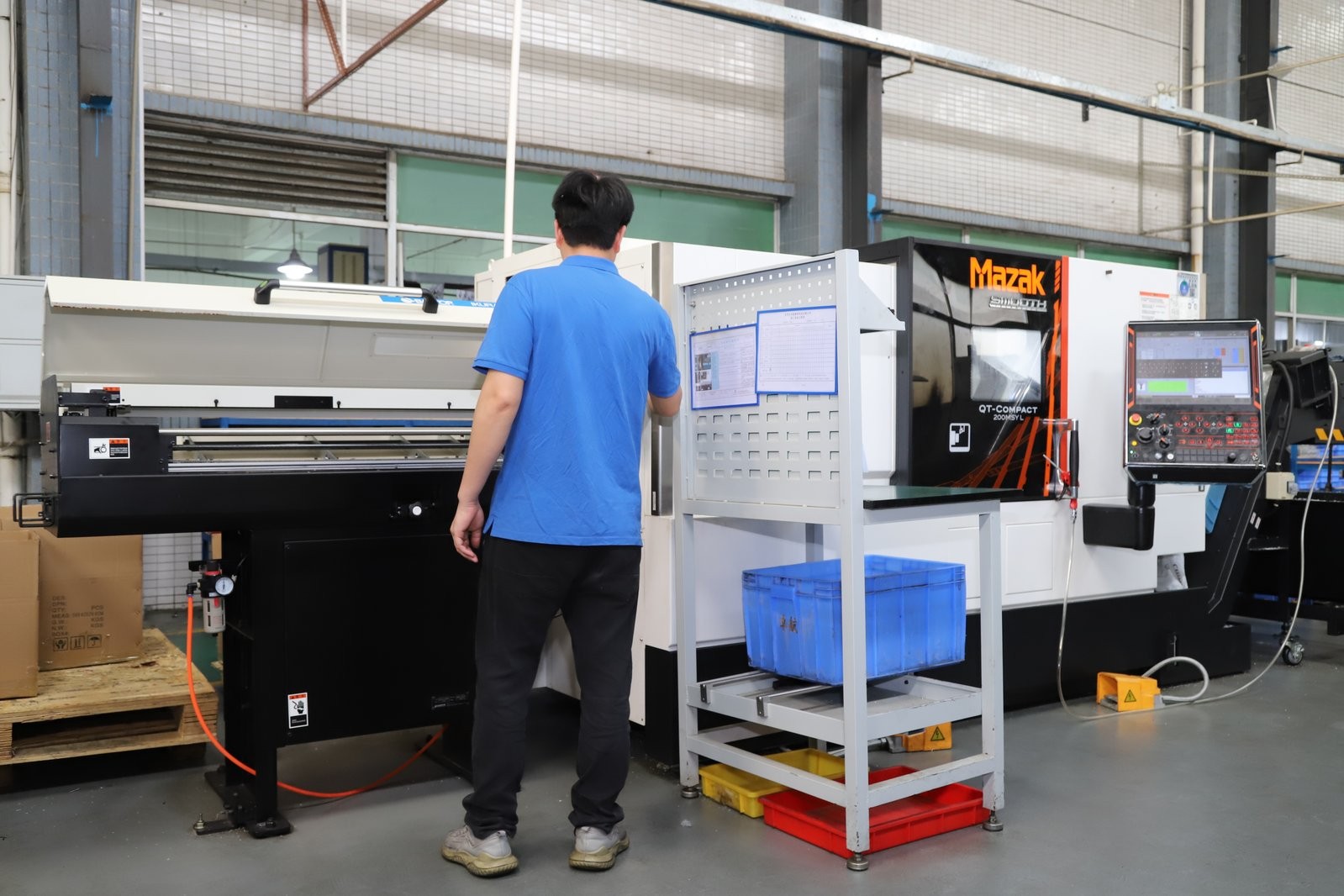
What a 4-Axis Machining Center Is
A machining center is a milling machine (typically a VMC) with an ATC that swaps tools automatically, so a single setup runs drilling, milling, tapping, and boring. Add a 4th axis rotary table and the part can be indexed or rotated to present multiple faces and around-diameter features to the spindle without manual re-fixturing. The upshot for you: more of the part finished in one clamping, better accuracy on cross-face relationships, and less labor.
How It Differs from a 3-Axis VMC and a 5-Axis Center
- vs 3-axis VMC: the rotary 4th axis removes the need to unclamp and re-indicate the part to reach side faces. That saves setups and protects accuracy.
- vs 5-axis center: a 4-axis rotary indexes/rotates around one axis but cannot tilt two ways like a 5-axis head. For deep undercut walls needing angled tool access, 5-axis wins; for indexed side and around-axis work, 4-axis is cheaper and sufficient.
What It Does Well
Excels at prismatic parts with features on several faces and round parts with radial features — manifolds, housings, brackets with side holes, hubs with bolt circles. If a 3-axis VMC would need two or three setups to reach everything, a 4-axis center likely does it in one. That is where the economics flip in your favor.
Specifying 4-Axis Center Work: Tolerances, RFQ Checklist
The key tolerance is the position of features relative to the rotation — governed by the rotary table's indexing accuracy and part locating. Send:
- Model + drawing showing which faces/angles carry features.
- Concentricity and position tolerances for around-axis features.
- Material grade and certification.
- Volume; 4-axis centers shine on repeated indexed work with pallet changers.
Common Mistakes Buyers Make
The frequent error is over-specifying the axis count: paying 5-axis rates when 4-axis (or even 3-axis) would do. The second: not flagging which features are around the rotation, so the shop under-budgets rotary accuracy. The third: splitting a part across a mill and a lathe when a 4-axis center (or a multi-axis lathe) could finish it complete.
How Zhuohang Approaches 4-Axis Centers
We route work to the least-capable machine that still meets your spec — 3-axis when enough, 4-axis when side/around-axis features demand it, 5-axis only when two-axis tilting is required. Our 100+ machine fleet includes 4-axis machining centers run with probing for accurate part location. One quality system (ISO 9001:2015, IATF 16949:2016) covers all, with Cpk reporting on production. Talk to [email protected] about the right process for your part.
What the extra axes actually buy
The axis count is about setups, not precision. A 3-axis machine cuts from one direction, so a part with features on several faces needs to be re-fixtured between operations - and every re-fixture introduces a small error. A 4-axis machine adds rotation, and a 5-axis machine can reach five sides in one setup, so the features on several faces stay in the same coordinate frame and line up. For a part that is a prismatic block, 3-axis is enough and cheapest; for a part with angled or multi-face features, the extra axes buy accuracy and fewer operations. You choose the axis count for the geometry, not by habit.
How to read an axis-based quote
If a part genuinely needs 5-axis work, the quote reflects one setup and tighter feature relationships; if a shop puts a 3-axis part on a 5-axis machine and charges for it, you are paying for capability the geometry does not use. This floor runs 3-, 4- and 5-axis machines including the Mazak VARIAXIS I-600 five-axis and the INTEGREX I-250H S mill-turn, at ±0.003 mm milled. Contact Felipe Iglesias at [email protected] or +86 13126536955 with the drawing and ask which axis count the geometry actually justifies.
How to verify the claim in one email
The fastest way to separate a real floor from a brochure is to ask for the machine list and the certificate numbers - and this facility answers in one email. Dongguan Zhuohang Ltd operates 100+ CNC machines across 6,800 m² in Hengli Town, Dongguan: Mazak VARIAXIS I-600 five-axis, INTEGREX I-250H S mill-turn, Brother SPEEDIO, and TSUGAMI, STAR and CITIZEN Swiss lathes. Inspection is on a Hexagon CMM with the 10:1 gauge rule, certification is to ISO 9001:2015, IATF 16949:2016 and ISO 14001:2015, and critical characteristics run at Ppk 1.67 initial and Cpk 1.33 in production.
Worldwide buyers across Europe, the Americas, Asia, Oceania and Africa are supplied from Dongguan. MOQ is 1 piece, lead times run roughly 3 / 7 / 30 days, and the quote from Felipe Iglesias ([email protected], +86 13126536955) comes back with the routing and the capability evidence together.
Take the next step
One drawing and one quantity is the whole hand-off. Send a STEP or IGES model and a 2D drawing with the tolerances, datums, material grade and finish, state the quantity and lead time, and the reply is an itemised quote - material, setup, cycle time, inspection - rather than a round number. If the drawing is incomplete, send what you have and the open questions; the point is to open the conversation, not to wait for a perfect package.
Contact Felipe Iglesias at [email protected] or +86 13126536955. MOQ is 1 piece, lead times run about 3 / 7 / 30 days, and the service area covers Austria, Belgium, the Czech Republic, Denmark, France, Germany, Greece, Hungary, Ireland, Italy, the Netherlands, Spain, Sweden and the United Kingdom in Europe; Brazil, Canada, Mexico and the United States in the Americas; China, Israel, Japan, Singapore and Sri Lanka in Asia; Australia and New Zealand in Oceania; and South Africa in Africa, shipped worldwide from Dongguan.
Tolerance and surface finish reference
±0.003 mm milled, ±0.002 mm turned, and ±0.002 mm ground or wire-cut, all verified on a Hexagon CMM against the datum scheme. Surface finishes span Ra 0.8 to 3.2 µm as-milled, Ra 0.2 to 0.4 µm ground, and Ra 0.05 to 0.1 µm polished. The 10:1 gauge rule governs every feature - the instrument must resolve ten times finer than the tolerance it checks. And the datum is what makes the tolerance real: read against two different datums, the same callout gives two different parts, so state the datum and the convention, ASME Y14.5 or ISO.
The material decision
Aluminium 6061-T6 leads on light and economical; 7075-T6 adds strength for aerospace and structural parts. In stainless, 303 machines cleanly for fittings, 304 and 316 add corrosion resistance, and 17-4 PH adds strength after ageing. Steel wins on strength and cost. Brass is the fastest metal to machine and conducts well. Copper C110 is the conductivity benchmark, with C145 tellurium copper for machinability. Titanium and Inconel hold high-temperature strength but machine slowly and cost more. The material is the biggest lever on price, so it is selected for the service - load, environment, temperature - not by habit, and the grade is named on the drawing so the mill certificate confirms it.
What a machining centre actually is
A machining centre is an enclosed CNC mill that changes its own tools from a magazine, so a part is roughed, finished, drilled and tapped in one setup without a human swapping cutters. A vertical machining centre (VMC) holds the part on a table under a vertical spindle and is the workhorse for prismatic metal parts. The benefit over a manual mill is the automatic tool change and the repeatability: the same program produces the same part on the first and the thousandth run.
Reading a machining-centre quote
you read a machining-centre quote by the operations and the tolerances, not by the machine. A part that needs several tools and several faces costs more because the program is longer and the setup is more work; a simple part is cheap. This floor runs 100+ CNC machines including the Mazak VARIAXIS I-600 five-axis and the INTEGREX I-250H S mill-turn, at ±0.003 mm milled. Contact Felipe Iglesias at [email protected] or +86 13126536955 with the drawing and the quantity.
The quality evidence behind every part
Every part ships with its evidence. Incoming stock is checked against the mill certificate - composition by XRF, hardness where specified - before machining. The first article is inspected in full against the drawing, critical characteristics run under statistical process control at Ppk 1.67 initial and Cpk 1.33 in production, and in-process checks hold the tolerance on a Hexagon CMM with the 10:1 gauge rule. The final report ships with the parts, so you get the product and the proof in one delivery - the line between a held tolerance and a claimed one.
your guide to quoting
Behind every good quote is a drawing that specifies. Name the material grade, not just the material; mark the datums and tolerances that actually matter; state the finish; and give a quantity, even a range. The more the drawing specifies, the less the shop assumes, and the closer the quote is to the real part. An itemised quote - material, setup, cycle time, inspection - lets you challenge the right line rather than negotiate blind, and it is the quickest path to a cheaper part: loosen a tolerance that does not matter, or raise the quantity to spread the setup. Send the drawing to Felipe Iglesias at [email protected] or +86 13126536955 and ask for it itemised.
De-risking a first order
Start with a handful of parts to confirm the routing and the tolerance, then scale. The same machines, the same inspection bench and the same certificate numbers apply to a single piece and a production run alike, so a small first batch is the proof that a large one will hold the same numbers.
Aluminium 6061-T6 is the fastest, most economical metal to machine on this floor, so an aluminium part in a standard finish is usually the quickest to quote and ship; stainless, titanium and Inconel each add time and cost for their properties.
What this shop actually runs
We machine every part in our own 6,800 m² plant in Dongguan, China, on 100+ CNC machines with 100+ staff. The machine list by category:
- 5-axis machining centres (10+) - Mazak VARIAXIS I-600 (510/910/510 mm travel, 12,000 rpm, 22 kW, 71.6 N·m, 30-tool BT40) and Mazak INTEGREX I-250H S (B-axis 0.0001°, 24 kW, 124 N·m, 38-tool HSK-A63). Cut on compound-angle parts, single-setup multi-face prismatic work, and aerospace fittings where datum transfer loss is unacceptable.
- 3-axis / 4-axis machining centres (50+) - Brother SPEEDIO S500Z2N / S700Z2N (10,000 rpm, 14/21-tool ATC, 0.7 s tool-to-tool, Z-axis 2.2 G) and Mazak VCE-430A L / VCE-570C L (10,000 rpm, 118 N·m, 24-tool ATC). Cut on prismatic parts, plates, brackets, housings.
- Swiss-type turning centres (10+) - Citizen Cincom A20-3F7 (Φ20 mm, 10,000 rpm), TSUGAMI B0206-III / B0205-III (Φ20 mm, 0.1 µm), STAR SR-32JII / SR-32J Type N (Φ32 mm, 8,000 rpm). Cut on long, slender rotational parts at ±0.002 mm.
- CNC turning centres (20+) - HEADMAN T70M/1250 (720 mm swing, 117 mm bore, 3,000 rpm, BMT75 12-station turret). Cut on shafts, bushings, flanges up to ±0.002 mm.
- Wire EDM (5+) - Sodick AQ535L (550/350/300 mm travel, ±20° taper, 800 kg workpiece). Cut on hardened tool steel, internal splines, sharp internal corners that milling cannot reach.
- Inspection: Hexagon CMM + 20+ gauges - Hexagon CMM for coordinate measurement, plus vision system, profilometer, hardness tester, coating thickness gauge, XRF for material verification. The 10:1 rule (gauge 10x more accurate than the band) is applied to every feature.
- Machine highlights - VARIAXIS I-600: one-setup multi-face 5-axis + MAZA-CHECK auto-calibration; INTEGREX I-250H S: DONE-IN-ONE mill-turn, B-axis 0.0001° + Ai thermal shield; SPEEDIO S500Z2N / S700Z2N: Z-axis 2.2 G + 0.7 s ATC; Swiss-type: guide-bush switchable + 0.1 µm resolution.
Tolerance: ±0.003 mm CNC milling / ±0.002 mm CNC turning / ±0.002 mm grinding and wire EDM. Capability: Ppk >= 1.67 initial on key characteristics, Cpk >= 1.33 ongoing.
Certificates: ISO 9001:2015 (116024/A/0001/UK/En), IATF 16949:2016 (131941/A/0001/SM/En, with design clause 8.3 excluded, stated openly) and ISO 14001:2015 (116024/B/0001/UK/En), issued to Dongguan Zhuohang Ltd, registration 91441900MA4UWT6X39, founded 2005.
Where we ship: Austria, Belgium, the Czech Republic, Denmark, France, Germany, Greece, Hungary, Ireland, Italy, the Netherlands, Spain, Sweden and the United Kingdom in Europe; Brazil, Canada, Mexico and the United States in the Americas; China, Israel, Japan, Singapore and Sri Lanka in Asia; Australia and New Zealand in Oceania; and South Africa in Africa — plus other countries and regions worldwide, shipped from our base in Dongguan, China.
Contact: Felipe Iglesias, [email protected], +86 13126536955.
Not sure whether 3, 4, or 5 axes fit your part? Send the drawing to [email protected] or use our process-selection guide for the right call and a transparent quote.
Frequently Asked Questions
When does a 4-axis center beat a 3-axis VMC?
When the part has features on multiple faces or around its diameter that a 3-axis VMC would need several setups to reach. The 4th axis holds those relationships in one clamping and cuts setup labor.
Is a 4-axis center cheaper than 5-axis?
Generally yes — lower machine-hour rate and simpler programming. If your geometry only needs indexed rotation, not two-axis tilting, 4-axis is the efficient choice.
What should I tell the shop about my part?
Which faces and angles carry features, the concentricity/position tolerances for around-axis features, material and certs, and volume. Distinguishing 3/4/5-axis needs from the start keeps the quote honest.
Continue reading: What Is 4 Axis CNC Machining · What Tolerance Can 4 Axis CNC Machining Hold · 3 Axis CNC Machining
Standards referenced on this page
- ASTM B211/B211M-19 — Standard Specification for Aluminum-Alloy Rolled or Cold Finished Bar, Rod, and Wire
- ASTM A276/A276M-17 — Standard Specification for Stainless Steel Bars and Shapes
- ISO 9001 — Quality management systems — Requirements